For the first time in years, parking bond proceeds in cash costs money instead of making it.
At its recent late July meeting, the FOMC voted 9–3 to hold the federal funds rate at 3.50%–3.75%. The dissents were the main story: three members wanted a hike, not a cut. Chair Kevin Warsh stressed in his press conference that the 2% inflation target is not being loosely interpreted after five-plus years of above-target readings, and that a run-up in energy prices (crude touched $113/barrel in April before easing) has kept price pressures uncomfortably elevated – seemingly reinforcing the sentiments of those three proponents of a rate hike. Markets have taken the hint with futures contract now assigning a roughly two-thirds odds to a quarter-point hike at the September 16–17 meeting, not a cut.
Most of the hawkishness can be attributed to the Strait of Hormuz. Since February’s strikes on Iran, the Strait has been intermittently mined, tolled, and closed outright, at one point cutting regional oil shipments by more than half and pushing Brent above $100 a barrel; the latest U.S.–Iran memorandum of understanding lapsed on August 17th, and transit has again slowed to a handful of vessels a day. The pass-through has broadened beyond energy prices alone into plastics, polymers, and freight-rerouting costs — the demand-driven component monetary policy actually targets — which is why market-implied odds of a September hike have climbed from roughly one-in-four in mid-June to well over half today.
For borrowers in the municipal market, this is the opposite of the reinvestment environment to which they’ve gotten accustomed. The reflex to “stay short and stay liquid while the Fed cuts” no longer describes what we’re seeing on the front of the yield curve.
The Front End Has Flipped
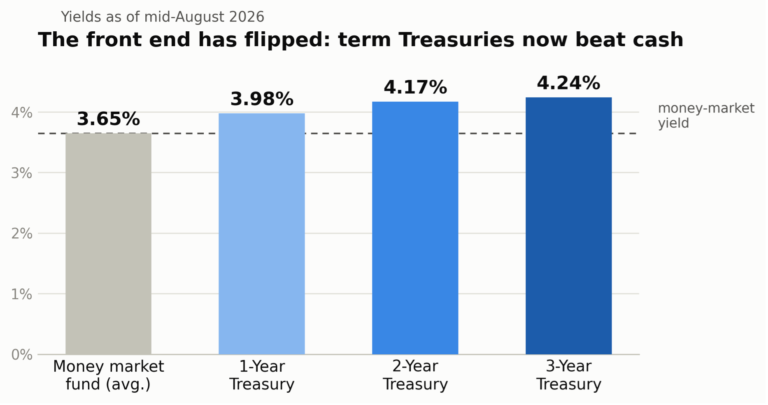
The practical consequence shows up in the 1–3 year sector of the curve. As of mid-August, top government/prime money market funds — often the default investment for unspent project funds — yield roughly 3.65%, essentially tracking the 3.63% effective funds rate. The 1-year Treasury, by contrast, yields 3.98%, with the 2- and 3-year notes at 4.17% and 4.24%. That is a 30- to 60-basis-point pickup available simply by terming out cash that would otherwise sit in a sweep account or money market fund — a gap that, by design, doesn’t exist when the Fed is expected to cut, and one most issuers haven’t seen in a long stretch.
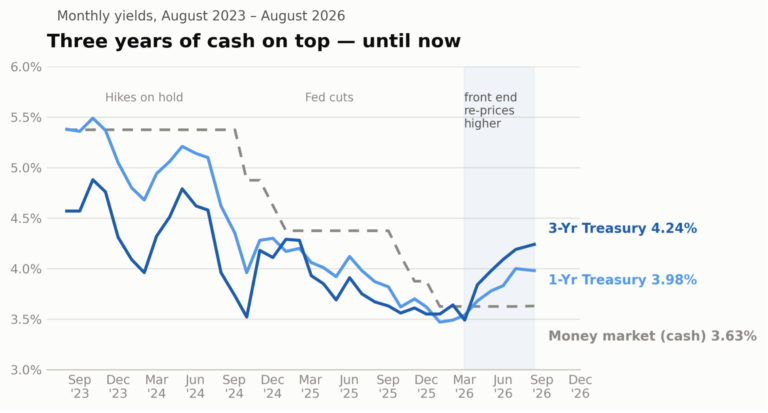
Zoom out and the move looks less like an anomaly and more like an actual reversal. The chart below shows the rates for the past three years. Cash has out-yielded both the 1- and 3-year note continuously since the hikes ended in mid-2023 — through the hold and through every cut in 2025. As Hormuz-driven inflation risk turned cut odds into hike odds this spring, that three-year run ended, and the front end climbed back above the money market rate for the first time in this cycle:
What This Means for Reinvesting Proceeds
A few things worth doing before your next draw schedule review:
- To the extent that you have confidence in your projected draw schedule, consider laddering your portfolio to those draws rather than defaulting to a sweep account. That is, match 1–3 year Treasuries and Agencies to your actual drawdown schedule rather than letting balances sit in a money market fund by default.
- Don’t over-extend on duration. With the market pricing meaningful odds of a September hike, the 1-year point may still move higher. Laddering short and rolling preserves the option to capture further increases rather than locking in today’s 3-year rate for cash that could be needed sooner.
- Revisit your investment policies and strategies. Many post-2022 policies were written to keep proceeds liquid while rates fell. If the default is still “money market fund unless otherwise instructed,” that default may now the more expensive choice.
Bottom line: the Fed’s hawkish hold has done something the front end hasn’t done in years — made staying in cash the costlier decision. For issuers with unspent proceeds, that’s worth a phone call before the next reserve fund or construction fund investment rolls over. To discuss what this means for your particular situation, please contact your Blue Rose advisor.
Sources: Federal Reserve, FOMC Statement, July 29, 2026; Federal Reserve H.15 Selected Interest Rates; U.S. Department of the Treasury, Daily Treasury Par Yield Curve Rates; CNBC, “Fed rate decision July 2026: Divided Fed holds interest rates steady”; U.S. Bank, “Federal Reserve Holds Rates at 3.50%–3.75% in July 2026”; Chase, “Will the Fed Hike Rates in September?”; YieldFinder money market fund yield data; Bankrate, “Federal Funds Rate History”; The Soufan Center, IntelBrief, August 17, 2026; CBS News, U.S.–Iran war live updates; Tech Times, “Iran Oil Shock Spills Into Demand Inflation, Lifting Fed Rate-Hike Odds”; Charles Schwab, “Iran, Inflation & Interest Rates: Bond Market Update.”
This note is for general informational purposes and does not constitute investment, legal, or tax advice. Reinvestment of bond proceeds is subject to arbitrage yield restriction and rebate requirements under Section 148 of the Internal Revenue Code; issuers should consult bond counsel before changing investment strategy.
Sam Gruer | sgruer@blueroseadvisors.com | 973-761-1741
Sam Gruer brings more than 30 years of capital market experience to his role as Managing Director at Blue Rose Capital Advisors, where he focuses on the firm’s business development efforts and providing senior advisory services. Mr. Gruer guides clients through the debt/swap/reinvestment transaction process by making strategic recommendations based on sound, thoughtful, and sophisticated analysis. During his career, Mr. Gruer has advised on and/or executed bond, derivative, and reinvest transactions totaling more than $50 billion for tax-exempt borrowers and financial institutions. He also offers expert advice on determining the optimal structure for reinvestment of bond proceeds by evaluating risk tolerance, identifying legal restrictions, and estimating cash flow needs for his clients. This expertise comes from serving as a structurer, trader, and marketer of interest rate derivatives and defeasance products at some of the largest banks and broker/dealers. He serves clients from our New York regional office.
In his latest role at Mesirow, Mr. Gruer specialized in serving Northeast and Southeast clients who issue general obligation and revenue-backed bonds and served as co-head of Mesirow’s Defeasance Solutions group. In 2008, Mr. Gruer co-founded Cityview Capital Solutions, serving as Managing Director and providing debt, swap, asset/liability management, and reinvestment advisory services to municipal and not-for-profit borrowers. His prior experience also includes leadership roles at Deutsche Bank as Director of Derivative Structuring, at JPMorgan Chase as co-founder of the municipal derivatives department, and at Prudential Securities as Head of New Products for the municipal securities division. Earlier in his career, he worked in municipal finance at Goldman Sachs and Morgan Stanley
Media Contact:
Laura Klingelhutz, Marketing Coordinator
952-208-5710