
With the 2026 midterm elections approaching, volatility remains the dominant theme across markets. The conflict with Iran, energy-driven inflation and a more hawkish Federal Reserve have pushed interest rates through sharp swings this year, shaping the borrowing environment for municipal issuers heading into November.
Inflation and Energy Prices
Inflation remains elevated as the election nears, driven largely by energy prices. Supply disruptions in the Strait of Hormuz, a key route for global oil shipments, have kept energy markets volatile, and Brent crude is again trading above $110 per barrel. That pressure is evident in the September Consumer Price Index (CPI). Released on October 14, it showed headline prices up 0.6% for the month and 3.7% from a year earlier, up from 3.4% in August. Energy accounted for most of the increase, as the energy index rose 5.2% in September and is up 20.4% from a year ago, with gasoline alone up 34.2%. Core CPI, which excludes food and energy, rose 0.3% for the second straight month and is up 2.6% year over year, compared with 2.4% in August. Underlying price pressures are building gradually, but energy continues to drive the headline number.
The Federal Reserve’s preferred measure, the Personal Consumption Expenditures (PCE) index, offered some relief in August. Core PCE rose 0.2% for the month, below the 0.3% forecast, and 3.0% year over year, below the 3.3% forecast. However, most of that miss reflected downward revisions to prior months rather than cooling in August. On the revised data, the year-over-year rate held at 3.0% and the monthly pace ticked up from 0.1% in July. The September PCE report, due the day after the Fed held rates steady, is expected to show another elevated reading. With Middle East tensions flaring again this month amid renewed threats of a U.S.-Israeli strike on Iran after the midterm elections, energy costs are likely to remain a headwind for inflation through year-end.
Interest Rate Movements and Impacts
Rate volatility has defined both taxable and tax-exempt markets heading into the midterms. Since the conflict with Iran began in late February, energy-driven inflation concerns have pushed yields sharply higher. From their late-February levels, the 10-year Treasury rose as much as 134 basis points and the 30-year as much as 103 basis points, while the 10-year MMD (a tax-exempt benchmark) rose as much as 171 basis points and the 30-year MMD as much as 107 basis points. Shorter maturities also moved sharply as markets priced in a more hawkish Fed. The 2-year Treasury rose as much as 154 basis points to a peak of 4.92%, and the 2-year MMD rose 161 basis points to 3.64%, with both reaching their highs in late September. By late September and early October, the run-up had pushed rates to multi-year highs, with the 10-year Treasury reaching 5.31% and the 30-year Treasury climbing to its highest level since 2002. Tax-exempt yields followed, with the 10-year MMD rising above 4% for the first time since 2008.
Rates have since eased from those highs. As of October 27, the 2-year, 10-year and 30-year Treasury yields stood at 4.70%, 4.99% and 5.30%, respectively, while the 2-year, 10-year and 30-year MMD stood at 2.66%, 3.46% and 4.85%. Shorter maturities have led the rally, with the 2-year MMD down 98 basis points from its peak, further steepening the curve. Even so, borrowing costs remain well above where they started the year. With the midterm elections on November 3, a likely Fed hike in December and continued uncertainty in the Middle East, further rate swings are likely ahead.
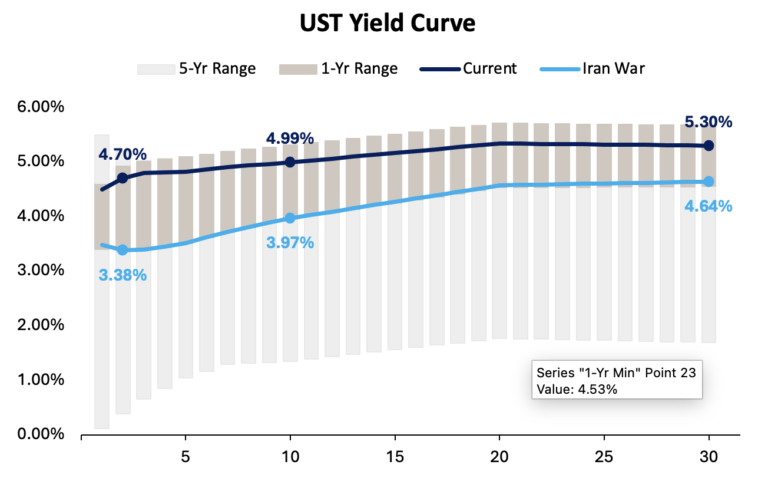
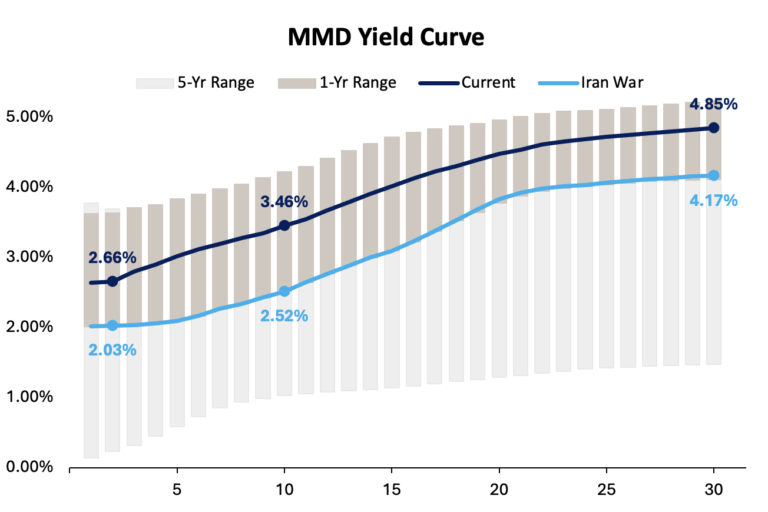
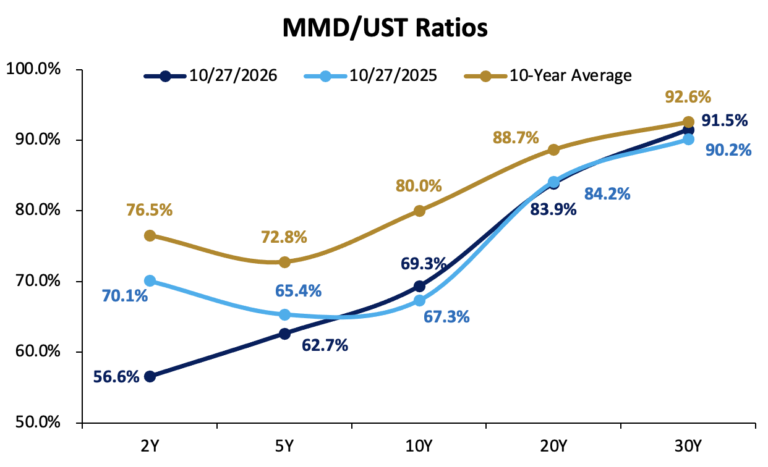
For issuers, the current rate environment presents both challenges and opportunities. The municipal yield curve remains steep, with the 30-year MMD roughly 219 basis points above the 2-year, which may favor shorter maturities, flexible call features or variable rate structures as ways to reduce borrowing costs. Variable rate debt, such as variable rate demand bonds or floating rate notes, can allow issuers to borrow at lower short-term rates now and convert to fixed rates once long-term rates improve. However, with the Fed leaning toward further hikes, short-term rates could rise, so issuers should weigh exposure to rate resets, liquidity facility costs and renewal risk against the potential savings. Muni-to-Treasury ratios remain below their long-term averages across the curve. The 2-year ratio stands at 56.6% compared with its 10-year average of 76.5%, the 10-year ratio at 69.3% compared with 80.o%, and the 30-year ratio at 91.5% compared with 92.6%. These levels indicate that tax-exempt borrowing costs are relatively favorable compared with Treasuries, particularly on the shorter end of the curve. However, with the 10-year MMD still roughly 76 basis points higher than a year ago, refunding opportunities remain limited. Issuers may benefit from continuing to monitor outstanding debt for savings and being prepared to act if rates pull back further.
The Fed and the Election
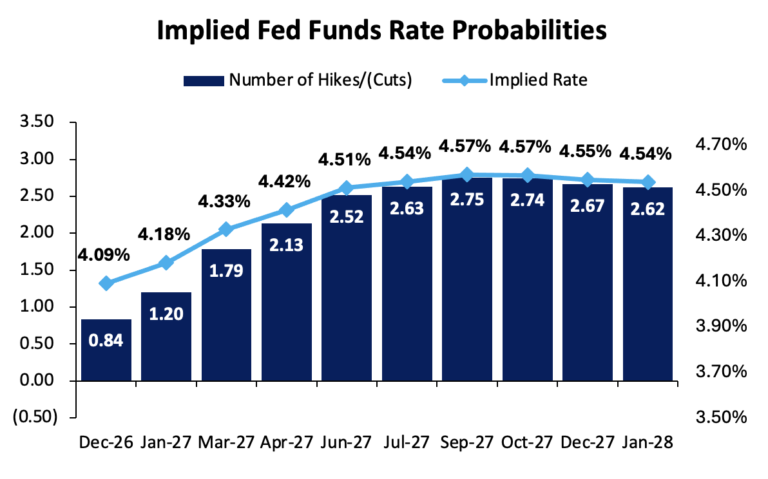
The Fed has reversed course from the rate cuts expected at the start of the year. After holding the federal funds rate at 3.50%–3.75% through the summer, it raised rates 25 basis points in September to a target range of 3.75%–4.00%, its first hike since 2023. At its October 27–28 meeting, the Fed held rates steady in a 10–2 vote, with Governor Lisa Cook and Cleveland Fed President Beth Hammack dissenting in favor of another 25-basis-point hike. The post-meeting statement noted that inflation “remains elevated”, and Fed officials have pointed to energy supply shocks as the primary driver. The central concern is that elevated fuel costs, particularly diesel, will feed through to transportation and production costs and lift prices across a broader range of goods and services, raising inflation expectations in the process.
Markets had largely anticipated the October hold, pricing in a 91% probability heading into the meeting, helped by the softer-than-expected August PCE reading and the recent pullback in Treasury yields. However, expectations for a December hike have firmed. Following the decision and two dissents in favor of a hike, markets are currently pricing in a roughly 84% chance of a 25-basis-point hike at the December 8–9 meeting.
Beyond the Fed, the midterm elections add another layer of uncertainty for the municipal market. Historically, election outcomes have had less lasting impact on interest rates than inflation and Fed policy, but the balance of power in Congress could shape several issues important to issuers. Chief among these is the tax exemption on municipal bonds, which has periodically surfaced in federal tax policy discussions and remains central to keeping borrowing costs low for state and local governments. The election may also influence the direction of federal infrastructure funding and aid, which many issuers rely on to support capital programs. In the near term, added volatility is likely in the days surrounding the vote, particularly with the September PCE report, the December Fed meeting and developments in the Middle East all in focus.
Outlook
The path for rates through year-end hinges largely on energy markets and the Fed’s response to them. A durable easing of tensions in the Middle East could relieve inflation pressure and give the Fed room to hold, while further escalation could keep yields elevated into the new year. In either case, issuers with upcoming financing needs are well served by staying flexible, keeping transactions ready to price during periods of relative calm, and working closely with their advisors as conditions evolve. If you have questions about how the election results may affect your organization, from potential changes to the tax exemption and federal funding to market conditions for upcoming financings, we encourage you to reach out to your Blue Rose advisor.
Meet the Author
Julia Cain | jcain@blueroseadvisors.com | 952-308-5712
In her role of Analyst, Julia Cain provides analytical, research, and transactional support to the lead advisory team serving higher education, non-profit, and government clients with debt and derivatives advisory and reinvestment services.
Prior to Blue Rose, Ms. Cain worked for Steelcase, a global manufacturing company, as a Sales Finance FP&A Intern in Grand Rapids, MI. In this role, she supported monthly and quarterly business reviews by preparing reporting packages, conducted variance analyses on sales performance, and collaborated with cross-functional teams to develop data-driven sales projections. Ms. Cain was responsible for deriving actionable financial insights from company data as well as key tasks for cashflow management.
Media Contact:
Laura Klingelhutz, Marketing Coordinator
952-208-5710